> For the complete documentation index, see [llms.txt](https://aptivi.gitbook.io/aptivi/llms.txt). Markdown versions of documentation pages are available by appending `.md` to page URLs; this page is available as [Markdown](https://aptivi.gitbook.io/aptivi/csharp-libraries/installation-and-upgrade/upgrade.md).
# Upgrade
Upgrading our library in your project
There are two ways to upgrade our library in your project:
* Using Visual Studio's NuGet package manager
* Manual upgrade
You can choose a way to install a package in a way you prefer.
***
## Visual Studio's NuGet package manager
{% hint style="info" %}
This only applies to those who are using Windows.
{% endhint %}
If you're using Visual Studio to build your project, it provides you an easy way to install NuGet packages, such as our libraries, into your project.
{% stepper %}
{% step %}
### Open your project
Open Visual Studio to a project that you want to upgrade our libraries.
{% endstep %}
{% step %}
### Open the NuGet package manager
Right click on either the project or the `Dependencies` entry beneath the project in the Solution Explorer pane and select `Manage NuGet packages...`
{% endstep %}
{% step %}
### Search for library updates
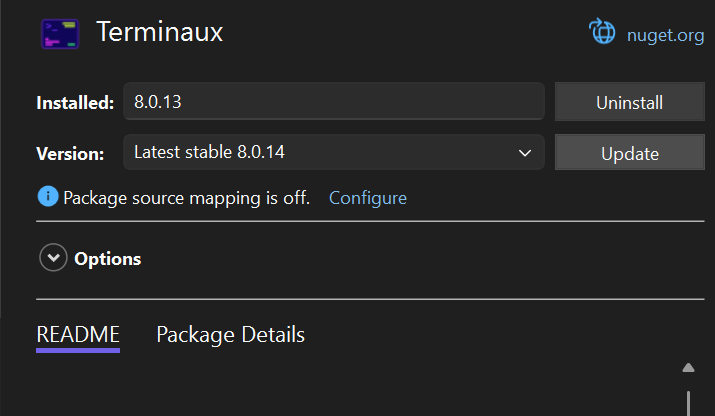
Click on `Updates`. Then, select the desired library you'd like to upgrade, such as Terminaux.
{% endstep %}
{% step %}
### Install a library
Click on any of the libraries that show up in the search results, and click on `Update`.
{% endstep %}
{% step %}
### Accept the license
If any package asks for your acceptance of the license, read the license contained by clicking on their license names, then click on `I Accept`.
{% endstep %}
{% step %}
### Verify the upgrade
The package is upgraded! Verify by expanding the `Dependencies` entry beneath the project and expanding the `Packages` entry.
{% endstep %}
{% endstepper %}
***
## Manual upgrade
If you'd like to manually upgrade a NuGet package to a project with your favorite editor or if you're unable to use Visual Studio for some reason, you can use this upgrade method. However, this method comes in two ways:
* Visual Studio
* Text editor
### Visual Studio
If you are using Visual Studio, follow these steps:
{% stepper %}
{% step %}
### Open your project
Open Visual Studio to a project that you want to upgrade our libraries.
{% endstep %}
{% step %}
### Open the project file
Double click on the project as shown in the Solution Explorer pane
{% endstep %}
{% step %}
### Update the version in a library reference
Look for the `PackageReference` property that targets a specific library (for example, Terminaux) and change the `Version` attribute (replace `8.0.14` with the desired version of the library)
```xml
```
{% endstep %}
{% step %}
### Save project and restore packages
Save the project file. It should automatically upgrade the required packages. If, however, the package restoration didn't automatically start, right-click on the solution and select `Restore NuGet Packages`.
{% endstep %}
{% endstepper %}
### Text editor
If you are using your favorite text editor, such as Visual Studio Code or Sublime Text, follow these steps:
{% stepper %}
{% step %}
### Open your project folder
Open the file explorer and navigate to the target project directory that contains the project file (not the solution `.sln` or `.slnx` file)
{% endstep %}
{% step %}
### Open your text editor
Right-click on the project file -> `Open With` -> your favorite text editor
{% endstep %}
{% step %}
### Update the version in a library reference
Look for the `PackageReference` property that targets a specific library (for example, Terminaux) and change the `Version` attribute (replace `8.0.14` with the desired version of the library)
```xml
```
{% endstep %}
{% step %}
### Save project and restore packages
Save the project file. Then, open the terminal emulator in your preferred way and execute `dotnet restore`.
{% endstep %}
{% endstepper %}